 |
|
 |
|
 |

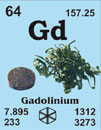
Gadolinium single crystal 64Gd157.25
Gadolinium was discovered in 1880 by J.C. Galissard de Marignac at Geneva, Switzerland.
Isolated in 1886 by P.E. Lecoq de Boisbaudren at Paris, France.
[Named after J. Gadolin, a Finnish minerologist]
French: gadolinium
German: gadolinium
Italian: gadolinio
Spanish: gadolinio
|
Description: Gadolinium is a soft, silvery metal of the so-called rare earth group
(more correctly termed the lanthanides). It reacts slowly with oxygen and water, and dissolves
in acids. Gadolinium is used in magnets, electronics, refractories, neutron radiography, and
alloyed with iron, for magneto-optic recording devices.
|
Metal single crystal properties
| State: |
Single crystal |
| Crystal structure: |
Hexagonal |
| Production method: |
Czochralski |
| Standard size: |
Diameter 6-10mm thickness 1-2mm |
| Orientation: |
(0001) |
| Orientation accuracy: |
<2°, <1°, <0.5° or <0.1° |
| Polishing: |
as cut, one or two sides polished |
| Roughness of surface: |
<0.03µm |
| Purity: |
99.99% |
Further Materials properties
| Crystal structure: |
(cell dimensions/pm), space group,
a-Gd h.c.p. (a=363.60, c=578.26), P63/mmc
b-Gd b.c.c. (a=405), Im3m
T(a->b)=1535 K
High pressure form: (a=361, c=2603), R3m |
| X-ray diffractions mass absorption coefficients: |
CuKa 439 (µ/r) / cm2g-1
MoKa 64.4 (µ/r) / cm2g-1
|
| Neutron scattering length: |
0.65 b/10-12 cm |
| Thermal neutron capture cross-section: |
49000 sa / barns |
| Density: |
7.89 g/cm3 |
| Melting point: |
1312.85 °C / 1586 °K |
| Boiling point: |
3265.85 °C / 3539 °K |
| Molar volume: |
19.90 cm3 |
| Thermal conductivity: |
10.6 [300 K] Wm-1K-1 |
| Coefficient of linear thermal expansion: |
8.6 x 10⁻⁶ K-1 |
| Electrical resistivity: |
134.0x10⁻⁸ [298 K] Wm |
| Mass magnetic susceptibility: |
+6.030 x 10⁻⁵(s) kg-1m3 |
| Young's modulus: |
54.8 GPa |
| Rigidity modulus: |
21.8 GPa |
| Bulk modulus: |
37.9 GPa |
| Poisson's ratio: |
0.259 GPa |
| Radii: |
Gd3+ 97; atomic 180; covalent 161 |
| Electronegativity: |
1.20 (Pauling); 1.11 (Allred); £3.3 eV (absolute) |
| Effective nuclear charge: |
2.85 (Slater); 8.22 (Clementi); 11.28 (Froese-Fischer) |
| Number of Isotopes (incl. nuclear isomers): |
23 |
| Issotope mass range: |
143m -> 163 |
Biological data
| Biological role: |
none, but acts to stimulate metabolism |
| Toxicity |
|
| Toxic intake: |
n.a. |
| Lethal intake: |
LD50 (chloride, oral, mouse)=>2000 mg kg-1 |
| Hazards: |
Gadolinium is mildly toxic by ingestion, but is a skin and eye irritant and a suspected tumorigen.
|
| Level in humans |
|
| Organs: |
n.a., but very low |
| Daily dietary intake : |
n.a. |
Total mass of element in average [70 kg] person: |
n.a., but very low |
Geological data
| Minerals: |
|
| Mineral |
Formula |
Density |
Hardness |
Crystal apperance |
| Bastnäsite |
(Ce, La etc.) Co3F |
4.9 |
4 - 4.5 |
hex., vit./greasy yellow |
| Monazite |
(Ce, La, Nd, Th etc.) PO4 |
5.20 |
5 - 5.5 |
mon., waxy/vit., yellow-brown |
| Chief ore: |
monazite, bastnäsite
|
| World production: |
c. 400 tonnes/year |
| Main mining areas: |
USA, Brazil, India, Sri Lanka, Australia, China |
| Reserves: |
c. 2 x 10⁶ tonnes |
| Specimen: |
available as chips, foil or ingots. Safe.
|
| Abundances |
|
| Sun: |
13.2 (relative to H = 1 x 10¹²) |
| Earth's crust: |
7.7 ppm |
| Seawater: |
|
| Atlantic surface: |
5.2 x 10⁻⁷ p.p.m. |
| Atlantic deep: |
9.3 x 10⁻⁷ p.p.m. |
| Pacific surface: |
6.0 x 10⁻⁷ p.p.m. |
| Pacific deep: |
15 x 10-7 p.p.m. |
| Residence time:: |
300 years |
| Classification: |
recycled |
| Oxidation state: |
III |
Other sizes and specifications on request
© 1996 - 2008 MaTecK GmbH - Im Langenbroich 20 - D-52428 Juelich - phone: +49 (0) 2461 / 9352-0 - fax: +49 (0) 2461 / 9352-11 - Contact: info@mateck.de
|
 |
|
|